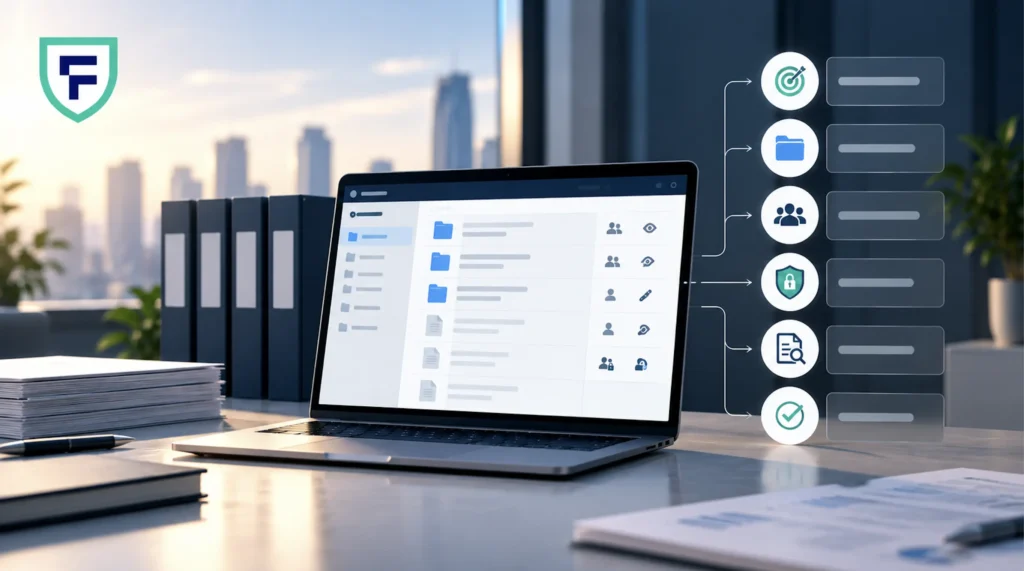


M&A technology has matured beyond a single platform. No one tool handles deal sourcing, due diligence, financial modeling, compliance, and integration planning. Modern dealmakers operate within integrated technology ecosystems where each category handles a specific function and shares data with the rest.
This guide covers the seven software categories that effective M&A teams use in 2026, with representative tools in each category and guidance on how they fit together.
1. Virtual Data Rooms
The Virtual data room (VDR) is the central hub of every M&A transaction. It handles secure document storage, controlled access, stakeholder collaboration, and compliance documentation. Every other tool in the stack connects to or draws from the data room.
Key requirements include AES-256 encryption, granular per-document permissions, integrated Q&A with tracking, dynamic watermarking, detailed audit trails, bulk upload, and unlimited storage. The user experience matters as much as the feature set because external parties (sellers, investors, auditors, legal counsel) need to navigate the platform without training.
Representative platforms include FirmsData (transparent pricing, unlimited storage, built-in deal management), Intralinks (enterprise-grade with global reach), iDeals (mid-market friendly with fast setup), and DealRoom (VDR plus project management).
2. Financial Data and Research Platforms
Valuation work requires market data, comparable transactions, company financials, and industry benchmarks. These platforms feed the financial models that drive pricing and negotiation.
Bloomberg Terminal ($24,000+ annually) provides real-time market data, news, and analytics. It remains the industry standard for large investment banks.
S&P Capital IQ ($15,000-$50,000+) excels at company financials, transaction comps, and Excel integration. Its plug-in is the workhorse of many valuation analysts.
Refinitiv Eikon ($5,000-$25,000+) offers similar capabilities with more pricing flexibility, making it a fit for cost-conscious firms.
PitchBook ($12,000-$25,000+) specializes in PE, VC, and growth company transaction data, including fund performance and LP data.
3. Due Diligence Automation
AI-powered tools that extract, classify, and analyze information from large document sets dramatically reduce review time. They complement VDRs by adding analytical capabilities on top of the secure document layer.
Kira Systems uses machine learning to extract relevant provisions from contracts, identifying change-of-control clauses, indemnification terms, and other critical language across hundreds of agreements.
Diligent provides governance, risk, and compliance (GRC) capabilities that integrate with due diligence workflows. It is widely used by boards and legal teams.
These tools do not replace human review. They accelerate first-pass analysis and surface information that manual reviewers might miss under time pressure.
4. Financial Modeling
Despite the proliferation of specialized software, Excel remains the foundation for custom financial models in M&A. Valuation models, LBO models, merger consequence analyses, and synergy models are all built in Excel.
What has changed is the ecosystem around Excel. Cloud-based collaboration (Microsoft 365) enables multiple analysts to work on models simultaneously. Add-ins from Capital IQ and FactSet pull live data directly into spreadsheets. And version control tools track changes across model iterations.
Dedicated modeling platforms like Foresight and Quantrix offer structured modeling environments that reduce formula errors and improve auditability, though adoption remains limited compared to Excel.
5. CRM and Deal Flow Management
Tracking relationships, pipeline, and deal status across the firm requires a CRM purpose-built for advisory work.
Intapp DealCloud is the leading CRM for investment banking. It provides relationship intelligence, deal flow tracking, AI-powered insights, and integration with external data sources.
MadeMarket is built by investment bankers for investment bankers. It offers deal tracking, contact management, pipeline analytics, and relationship scoring in a clean interface.
Generic CRMs like Salesforce can be adapted for deal flow, but the configuration effort is substantial. Purpose-built tools deliver faster time to value.
6. AI and Advanced Analytics
AI is moving from novelty to necessity in M&A. The most practical applications include contract analysis (extracting and comparing terms across large agreement sets), financial anomaly detection (identifying unusual patterns in revenue, expenses, or balance sheet items), natural language search (finding information across unstructured document sets using meaning rather than exact keywords), and predictive analytics (modeling deal outcomes based on historical transaction data).
AlphaSense uses NLP to accelerate research synthesis across earnings transcripts, news, and filings. Palantir offers data integration and analysis capabilities for complex, multi-source datasets.
7. Collaboration and Communication
Deal teams need real-time communication channels that integrate with their workflow tools.
Microsoft Teams handles integrated communication, video conferencing, and document collaboration within the Microsoft 365 ecosystem. Slack provides channel-based messaging that works well for deal-specific workstreams with external advisors.
Many VDR platforms, including FirmsData, now include built-in task management and Q&A features that handle deal-specific coordination natively, reducing the need for separate project management tools.
Building an Integrated Stack
The most effective approach is to start with a VDR as the central hub. Document management, collaboration, and compliance all flow through the data room. Layer specialized tools around it based on your deal volume, team size, and complexity requirements.
Integration matters. Verify that tools in your stack can share data (through APIs, exports, or native integrations) to avoid creating silos where information gets trapped in one platform and is unavailable in another.
For mid-market firms, starting with a VDR that includes built-in deal management (like FirmsData) plus a financial data platform (Capital IQ or PitchBook) provides strong coverage without excessive tool sprawl. Add specialized due diligence automation and CRM as deal volume grows.